Portrait libraryZhaunil Maerabban
Drow / Wizard
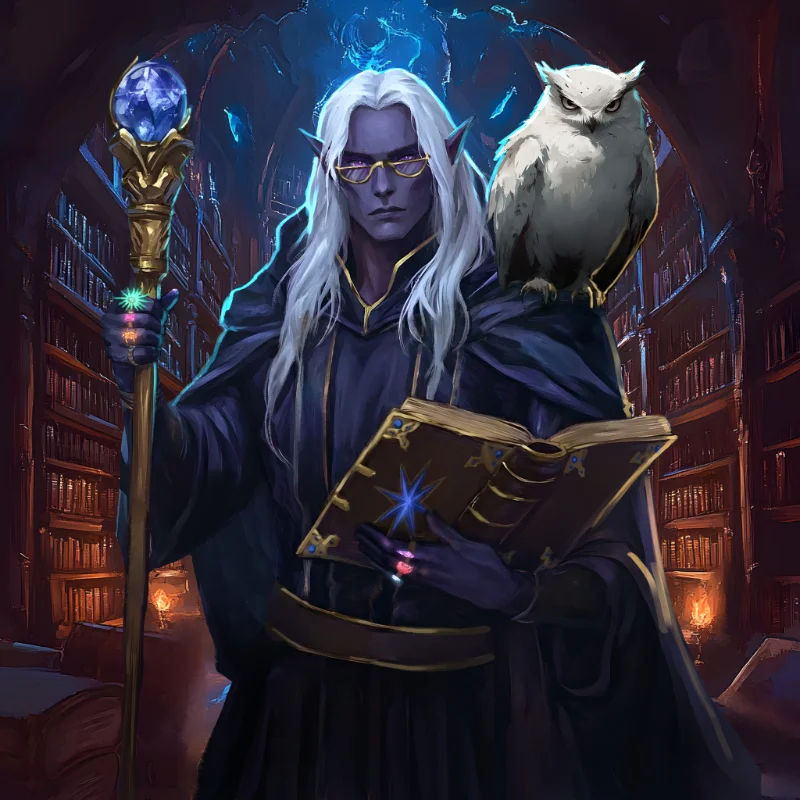
Submitted character story
Zhaunil Maerabban was born in Sshamath, the City of Dark Weavings — a drow city where wizards, not priestesses, hold the greatest power. From an early age, he was quiet, observant, and unusually patient for one raised among the intrigues of the Underdark. His tutors expected him to become a spy, strategist, or ruthless arcane rival. Instead, Zhaunil became something far more inconvenient to them: a scholar who valued knowledge even when it could not be immediately turned into leverage.

He showed a natural talent for divination, sensing patterns before others noticed them — the flaw in a spell, the hidden fear behind a lie, the direction events were likely to bend. In Sshamath, such gifts were usually tools of advantage. Zhaunil learned those uses well enough to survive, but he never found them satisfying. To him, divination was not merely a weapon. It was a way to ask why the world moved as it did.

That curiosity made him useful. It also made him careless in ways he did not recognize.

He filled journals with studies of Underdark cultures, faerzress, divine influence, mortal behavior, and the strange bond between faith and magic. His early notes were precise, detached, and sometimes arrogant. He was fascinated by belief, but often wrote of it as though faith were a mechanism to be dismantled rather than a living part of someone’s soul. Only later would he begin to understand that knowing the shape of a prayer was not the same as understanding the person who spoke it.

His curiosity eventually turned toward the surface. At first, it was only another subject of research. He collected maps, holy texts, travelers’ accounts, astronomical charts, and old elven writings. He became fascinated by the lives of other mortal peoples: humans with their brief, brilliant ambitions; dwarves and their ancestral memory; elves and their sorrowful patience; halflings and their quiet courage; tieflings, dragonborn, orcs, goliaths, and countless others whose customs unsettled or surprised him.

During an expedition into the Upperdark, Zhaunil discovered a ruined shrine near a fissure where moonlight touched the stone. There he found a damaged star-map marked with prayers to Sehanine Moonbow and Mystra. When he finally climbed high enough to see the open night sky, he stood beneath it for hours in silence.

The vastness did not frighten him.

It made him feel, for the first time, that his questions were too small.

After that, Zhaunil began visiting the surface whenever he could. He did not abandon his drow heritage, nor did he romanticize the world above. The surface was not kinder, only different. It had tyrants, liars, hungry gods, frightened villagers, cruel nobles, and scholars as vain as any archmage of Sshamath. But it also had a kind of honest wonder that he had rarely seen below: festivals held for no strategic purpose, roadside shrines tended by hands that expected no reward, songs taught to children simply because someone wished them remembered.

He studied these things awkwardly at first. He asked questions too directly. He mistook hospitality for ritual obligation. He offended a priest by trying to compare divine grace to a repeatable arcane phenomenon. He learned, slowly, to listen before he wrote.

Deities fascinated him most of all — not as a worshiper, at least not at first, but as a researcher trying to understand why gods answer some prayers, ignore others, and shape entire civilizations through faith. Mystra, Sehanine, Oghma, Savras, Eilistraee, Corellon, Lolth, and stranger powers all found their way into his notes. He did not trust any simple explanation. He distrusted even more the people who claimed to possess one.

His downfall came when his private journals were discovered.

They contained hundreds of pages on surface cultures, divine traditions, and the possibility that drow isolation had narrowed their understanding of the world. Worse, they questioned whether Sshamath’s rejection of priestly rule had truly freed it from dogma, or merely replaced one kind of certainty with another. His masters ordered him to surrender his work and submit to magical examination.

Zhaunil refused.

Not dramatically. Not bravely. He simply placed one hand over his satchel and said that unfinished research should not be destroyed by frightened minds.

That answer made him a danger.

He fled Sshamath with his spellbook, several incomplete journals, a darkwood staff set with crystal, and a white owl familiar named Soryndel, who had appeared to him during one of his nights beneath the stars. He does not fully understand Soryndel. The owl behaves like a familiar, but at times seems to know paths, names, and omens Zhaunil has never taught it. Whether Soryndel is a gift, a guide, a warning, or simply a strange companion remains one of the few mysteries Zhaunil has resisted dissecting too quickly.

Since then, Zhaunil has lived as an itinerant scholar across Faerûn. He has studied in Candlekeep under aliases, debated priests of Oghma, observed rites of Mystra, consulted diviners of Savras, copied fragments of Netherese inscriptions, and gathered oral histories from villages too small for most maps. Yet his work remains incomplete. For every answer, he has found three contradictions. For every pattern, a choice that breaks it.

Calm, courteous, and deeply curious, Zhaunil rarely judges belief openly even when he does not share it. He would rather ask questions than make accusations. Still, he is not without flaws. He can become so focused on understanding someone’s fear that he forgets to comfort them. He sometimes treats danger as an opportunity for observation longer than wisdom allows. When frightened, he retreats into analysis, because facts feel safer than feelings.

Many still fear him for being drow. Zhaunil accepts caution with patience, though not without private hurt. He knows trust cannot be demanded. It must be tested, proven, and sometimes rebuilt after no wrongdoing of his own. Companions matter to him for that reason. Alone, he can collect knowledge. With others, he is forced to understand what knowledge costs, whom it serves, and when a question should be set aside for the sake of a living person.

To Zhaunil, divination is not prophecy carved in stone. It is the study of possibilities. The future is shaped by choice, chance, divine will, mortal fear, and hidden causes too small to notice until it is too late. His magic grants glimpses of what may come, but he treats every vision as a hypothesis, never a certainty.

Recently, his research has led him to troubling signs: failed divinations, contradictory omens, unstable magic, and dreams shared by strangers across Faerûn. He believes these are not isolated events, but symptoms of a deeper wound in the Weave.

He does not yet know what caused it. He does not know whether the gods are silent, divided, deceived, or afraid. He does not know whether his exile was merely a personal misfortune or one small movement in a much larger pattern.

Zhaunil does not follow this mystery as a hero, zealot, or chosen one.

He follows it as a researcher — calm, patient, fallible, and determined to understand the world before the pattern breaks.

And perhaps, though he would be slow to admit it, he follows it because somewhere between the Underdark and the open sky, he began to care whether the world survives.