Portrait libraryVeyscar Ignivar
Human / Pyromancer
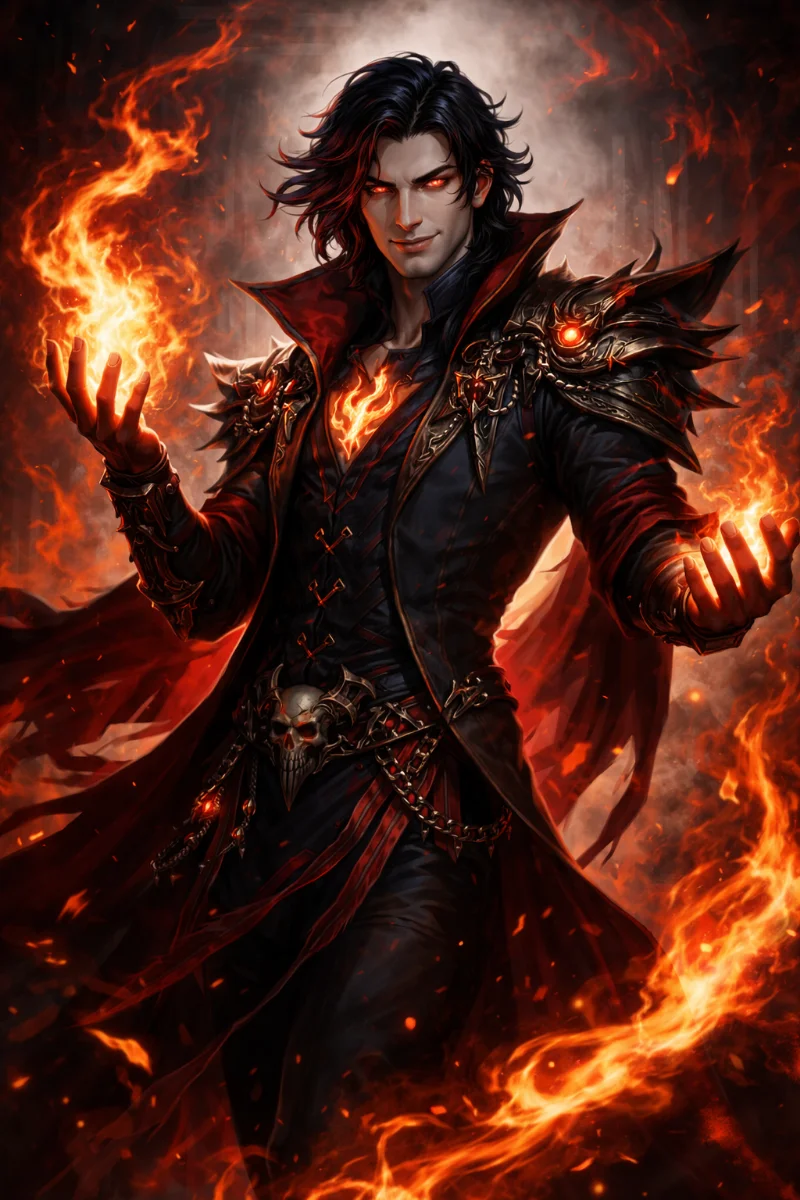
Submitted character story
History
The Woman Who Lit the First Fire
Akemi Soryu

Veyscar Ignivar met Akemi Soryu by accident, though later he would come to believe that nothing about her had ever been accidental.

She lived near the river districts of Kamigawa, where the old shrines leaned and the lacquer peeled, where the strictness of tradition softened just enough for people to survive. Veyscar had gone there chasing rumors—quiet gatherings of artisans and hedge-mages who shared knowledge outside the sanctioned lineages, people who believed the world did not belong solely to the old families and their dead ancestors. He arrived angry, already burning with the familiar frustration of seeing suffering treated as order.

Akemi was there tending a shrine that few remembered to pray at anymore. She was tall, spare in frame, her black hair usually tied back loosely because she hated how it got in her way. Her robes were plain and often stained with ink or ash, the marks of someone who worked with her hands and didn’t care how that looked to others. When she spoke, it was softly—but not timidly. There was thought behind every word, and patience behind every pause. Her eyes were dark and attentive, the kind that made people feel listened to even when they were being disagreed with.

Their first conversation was an argument. Veyscar ranted about systems designed to keep power locked away, about how laws were written to preserve suffering while calling it balance. Akemi listened until he ran out of breath. Then she told him that fire alone could destroy injustice, yes—but it could not rebuild what people needed to live. Fire needed direction, she said. Purpose. Otherwise it only left more ash.

He didn’t know why that stopped him, but it did. From that moment on, they were rarely apart. Akemi believed change had to be cultivated, not forced—that if people were given tools, knowledge, and mutual support, they would build something stronger than fear ever could. Veyscar believed corruption had to be burned away completely before anything new could take root. Instead of clashing, those beliefs fused. Together, they found a rhythm that felt dangerous and right.

They helped villages bypass corrupt officials by organizing trade networks that didn’t rely on sanctioned channels. They taught literacy, basic magic, and craftsmanship to people forbidden from learning such things. When authorities threatened their work, Veyscar stood at the edge of their gatherings like a living warning, fire dancing across his hands—not to attack, but to remind everyone watching that cruelty would not go unanswered.

Akemi kept the movement from becoming reckless. She planned distribution routes, mediated disputes, and reminded Veyscar that people were not fuel for his ideals. When he burned too hot, she cooled him. When she doubted whether kindness was enough, he stood ready to prove that strength could protect it. For the first time in his life, Veyscar believed the world could be reshaped without becoming monstrous in the process.

That belief did not survive. Someone betrayed them. Veyscar never learned who, and in some ways that uncertainty was worse than knowing. While he was away securing supplies, Akemi was taken. Not by assassins, not swiftly or quietly—but publicly, deliberately. The people responsible did not want her dead quickly. They wanted her broken.

They used magic meant to humiliate as much as harm. They mocked her ideals, twisted her compassion into a lesson, made sure the suffering was visible enough that fear would spread faster than hope ever had. This was not justice. It was a warning to anyone who thought the world could be better.

Veyscar arrived too late. Akemi was still alive when he found her, barely, her body ruined in ways no fire could undo. She recognized him. She smiled, faintly, as if seeing him was enough to make the pain recede for a moment. She told him not to burn the world for her. She told him that what they built mattered—even if it ended here. She died in his arms as everything they had created collapsed around them.

Veyscar did not accept it. The scream that tore from him was not rage at first—it was refusal. Refusal to live in a world where goodness was punished so thoroughly. Refusal to accept that cruelty was the price of order. Refusal to let her suffering be the final word. His fire erupted outward, uncontrolled and desperate, grief given form so violently that reality itself recoiled.

The ground vitrified beneath his feet. The sky split. And as his pain eclipsed the plane itself, his planeswalker spark ignited. Kamigawa vanished in a storm of flame and color, leaving behind nothing but scorched streets, broken systems, and a story no one would ever fully understand.

Akemi Soryu became the axis around which Veyscar’s life would turn forever after. She is the reason he does not lie. The reason he believes power can help people—if held firmly enough. And the reason he no longer trusts a world that calls suffering necessary. Before Akemi, he wanted equality for everyone. After her, he decided equality would have to be enforced—and that fire, properly wielded, could make the world listen.

Dominaria: Power with a Purpose?

Dominaria did not heal Veyscar Ignivar, but it gave him space to function again. The plane was loud with history, scarred by wars and miracles alike, and no one looked twice at a man who carried fire in his hands and grief behind his eyes. On Dominaria, power was not whispered about—it was documented, argued over, weaponized, and studied. That suited him. He buried himself in arcane research, battlefield theory, and the slow discipline of learning how to make his flames precise. Fire stopped being an emotional outburst and became an instrument.

Seraphine Altraxis

It was there that he met Seraphine Altraxis.

She was a paladin of an old Dominaria order, sworn not to blind idealism but to structured justice. Seraphine was tall and broad-shouldered, her presence unmistakably solid. Her armor bore scars that had not been polished away, and her blonde hair was usually braided tight to keep it from interfering with her work. Where Akemi had been soft-spoken and patient, Seraphine was direct—sharp-eyed, uncompromising, and impossible to intimidate.

Their first meeting was not gentle. Veyscar had been interrogated after a violent incident involving a rogue summoner. Seraphine was assigned to determine whether he was a threat or an asset. She challenged him openly, questioned his methods, and refused to flinch when his temper flared. Instead of fear, she met him with scrutiny—and something like respect.

She didn’t try to change him. That was how she won him. Seraphine believed in accountability, but she also believed in results. She saw Veyscar as a weapon that could be guided, not destroyed. Over time, she involved him in sanctioned campaigns—targeted strikes against warlords, cult leaders, and destabilizing forces that threatened civilian populations. For the first time since Kamigawa, his power had permission to exist.

Veyscar fell for her because she stood her ground. She fell for him because he listened—because beneath the fire, he wanted desperately to be useful, to matter, to protect rather than simply annihilate. With her, he convinced himself that discipline could replace loss, that devotion to order could keep the past from repeating. They married quietly. For a time, it worked.

The Whispered Offer

It was during this period of relative stability that the demon found him. It did not arrive with horns and flame, but as a scholar—well-spoken, patient, and disturbingly informed. It spoke of Akemi not as a memory, but as a possibility. It described a ritual older than Dominaria’s recorded history, one capable of restoring a soul lost to cruelty rather than fate.

The cost was enormous. The ritual required blood willingly given, souls taken from those already damned, and a focus of intense emotional resonance—fire bound by grief. It was forbidden not merely because it was dangerous, the demon claimed, but because it proved resurrection was possible in ways the powerful wished to control.

Veyscar did not tell Seraphine. He told himself it was mercy—to spare her the burden of knowing what he would attempt. In truth, it was fear. Fear that she would stop him. Fear that choosing Akemi would mean losing Seraphine. The ritual site was hidden beneath ruined stone, carved with sigils that burned the eyes to look at. As Veyscar began the incantation, fire and shadow twisted together. Screams echoed—some real, some memories dragged screaming from his mind. He offered everything the demon asked for.

Seraphine Altraxis last fight with Veyscar

And it failed.

Not cleanly. Not mercifully. The magic collapsed inward, consuming itself in a howl of mockery. The demon revealed the truth then—that it had orchestrated Akemi’s death, that this suffering was merely a continuation of its work. It vanished laughing, leaving behind only ash, corpses, and a man finally forced to face what he had done.

Seraphine found him before he could flee. She arrived in full armor, radiant with righteous fury and heartbreak in equal measure. She took in the ruined chamber, the bodies, the sigils still burning into the stone. She listened as he tried to explain—not excuse, but explain—that he had only wanted to undo one unbearable wrong. She told him she still loved him. Then she told him she could not allow him to walk free. To Seraphine, justice was not vengeance—but it was absolute. She offered him arrest, trial, containment. A chance to atone through submission to law. To Veyscar, it felt like betrayal layered atop betrayal. They fought. Not as enemies—but not as lovers either.

Fire clashed against holy radiance, the chamber tearing itself apart as Veyscar tried desperately not to kill her. Seraphine did not hold back. She struck to incapacitate, to bind, to end the threat he had become. When Veyscar finally unleashed a wall of flame to force distance between them, it scorched her armor and flesh alike. She screamed—but did not fall. The sound haunts him still. He fled through the fire, planeswalking away before she could finish the binding prayer meant to drag him back.

Aftermath

Seraphine survived. She carried the burns as both wound and penance, telling herself she should have seen the signs sooner. She reported Veyscar as a catastrophic failure—an asset corrupted beyond redemption. She still prays for him, though she will deny that to anyone who asks.

Veyscar left Dominaria convinced that love bound to duty was conditional. He had chosen desperation. She had chosen law. And in that moment, something hardened inside him. If justice would always turn on him when it mattered most, then he would never again allow himself to be powerless beneath it. Love, he learned, was not enough. Only control could keep loss from repeating. By the time he reached Wisonia, Veyscar Ignivar no longer believed redemption was something that could be given, seized—or burned for. Once Lost it was gone, fickle fate had shown him this.

Veyscar fled to Wisonia, dragging his sins behind him like smoke. It was there he stopped pretending. If the Multiverse punished idealism, then power would be his shield. If people worked better when happy—or afraid—then he would give them one or the other. He does not lie. He does not pretend to be kind. He simply offers results. Money. Influence. Firepower. Those who benefit from his rule thrive. Those who resist burn.

At his side stands Bob Himothey, his assistant from Dominaria—equal parts administrator, fixer, and quiet conscience. Bob doesn’t worship Veyscar, but he understands him. Someone has to manage the empire while the firestorm thinks bigger. Though Bob wasnt sure how he got dragged to Wisonia he wasn't going to let a new frontier pass him by.

Appearance

He has the kind of presence that makes a room subtly orbit around him.

Veyscar is tall and lean, built with a duelist’s grace rather than brute force. His face is sharp and handsome in a dangerous way—high cheekbones, a strong jaw, and a perpetual half-smirk that suggests he knows more than he’s saying. His skin is pale, warmed by the glow of embers rather than sunlight.

His hair is jet black, slightly wavy and tousled, falling to about his shoulders, with faint red highlights that catch the light like sparks hidden in ash. His eyes are unmistakable: deep ember-red, glowing softly like banked coals, giving the impression that fire is always burning just beneath the surface. When he focuses, the glow intensifies, hinting at the destructive power he keeps tightly leashed.

He normally wears finely crafted black and crimson attire—part armor, part noble’s coat. The leather and metal are etched with subtle infernal and arcane motifs, scorched at the edges as if they’ve survived countless fires. A fiery sigil burns faintly at his chest, visible through the open front of his coat, pulsing like a living flame. His pauldrons and accessories are ornate but restrained, favoring elegance over excess, with glowing red gemstones set into dark metal.

At his waist hangs a skull-worked belt clasp and light chains, adding a macabre flair without tipping into grotesque. His hands—each with exactly five fingers—are steady and expressive, marked by faint scorch lines and calluses earned through spellcasting. Even when relaxed, there’s a subtle heat shimmer around them, as if fire answers him instinctively.


Personality

Veyscar Ignivar is a man who has learned to live with fire instead of trying to put it out. He is blunt, charismatic in a way that cuts rather than comforts, and deeply pragmatic—someone who no longer believes the world rewards goodness unless it is enforced. He does not lie, not out of virtue, but because deception feels inefficient and beneath the certainty he’s cultivated. Power, to him, is both a shield and a tool: with enough of it, he can make life easier for himself and safer for those who serve him, and he genuinely believes that people thrive better when stability is bought with strength. Beneath his ambition lies a scarred idealist who still wants to help others, but only on his terms, and only if it does not leave him vulnerable again. Love taught him hope, duty taught him betrayal, and fire taught him control—and now he moves through the Multiverse building, burning, and reshaping whatever stands between him and a future where nothing he cares about can be taken from him ever again.

Loves

Veyscar Ignivar takes his joy in things that give him control without illusion and pleasure without vulnerability. He loves the honest heat of fire—watching it respond instantly to his will, never hesitating, never betraying him. He finds comfort in structure he builds himself: ledgers balanced, plans unfolding exactly as predicted, people thriving because he made the conditions right. Wealth isn’t about excess so much as ease; he enjoys good drink, well-made clothes, a quiet room where no one can interrupt him unless he allows it. He takes a particular satisfaction in competence—his own and others’—and genuinely enjoys rewarding those who do their jobs well, especially when loyalty grows from gratitude rather than fear. On rarer, quieter nights, he allows himself to savor moments that echo a softer past: shared meals, honest conversation, the hum of a place that feels briefly like home. He does not chase love anymore, but he still cherishes warmth—so long as it cannot burn him first.

Fears

Veyscar Ignivar’s greatest fear is not death, but powerlessness—the moment when something he values is taken from him and he is once again too late to stop it. He fears trusting deeply enough that another person gains the authority to choose something over him, the way duty once did, because that choice proved that love can still abandon him when rules are invoked. He fears being ruled by hope again, of believing that kindness alone can protect what matters, only to watch it be punished. Beneath all his ambition lies a quieter terror: that no amount of fire, wealth, or empire will ever truly insulate him from loss—that despite everything he builds, the universe may still find a way to take what he cares for most and leave him standing in the ashes, forced to endure rather than burn his way free.

Hobbies

Veyscar Ignivar’s hobbies are quiet, deliberate extensions of his need for control and understanding rather than escapism. He enjoys refining his pyromancy in controlled environments—experimenting with temperature, shape, and duration not for spectacle, but for precision, treating fire like a craft rather than a weapon. He has a fondness for study, particularly histories of fallen empires, forbidden rituals, and economic systems, reading them not out of nostalgia but to understand where power fractures under strain. In more mundane moments, he takes genuine pleasure in fine drink and food, favoring quality over excess, and will spend long hours perfecting a single recipe or blend if it suits his mood. Occasionally, he indulges in strategic games—war tables, probabilistic puzzles, anything that lets him test outcomes and human behavior without real consequences. These hobbies are how he relaxes: not by forgetting the world, but by mastering small, controllable pieces of it.

Family
None
Friends
Bob Himothey
Enemies
Seraphine Altraxis
Aspirations

Veyscar Ignivar aspires to a future where nothing meaningful in his life exists at the mercy of chance, law, or someone else’s sense of righteousness. He wants to build an empire that spans planes—not for conquest alone, but for permanence, a structure so well-funded, well-defended, and carefully managed that loss becomes an anomaly rather than an inevitability. Power, to him, is not an end but insulation: enough influence, wealth, and force that no demon can manipulate him, no institution can judge him, and no beloved can be taken without consequence. Beneath the ambition lies a quieter, more dangerous desire—to prove that the world was wrong to punish hope, that by becoming something close to a god he can succeed where ideals failed, reshaping reality on his own terms so that suffering is no longer dictated by weakness, but by choice.