Portrait libraryTrogdor
Dwarf / Warlock
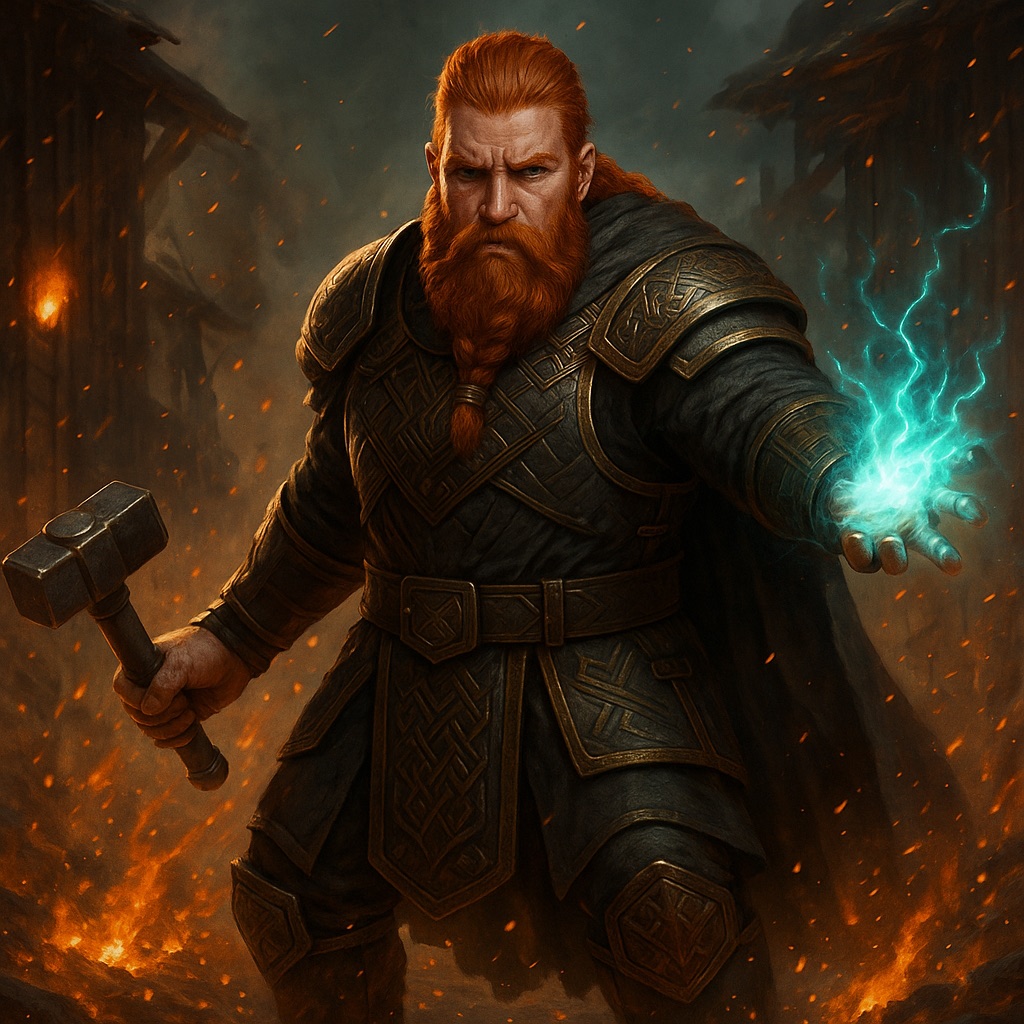
Submitted character story
Trogdor, the Kingmaker

Long before men whispered his name like a warning, Trogdor was called the Kingmaker.

He never chose the title.

Kings did.

Whenever a border collapsed, a rebellion threatened a throne, or some lord’s war had gone too badly for polished knights and decorated generals to salvage, they sent for the dwarf with the copper-red beard and the warhammer scarred by a hundred battles. Trogdor did not command armies from horseback. He fought among them. He broke shield walls with his own hands, dragged wounded soldiers from burning fortifications, and stood in breaches everyone else had already abandoned.

He became very good at winning other men their kingdoms.

Trogdor believed that mattered once.

He believed a soldier’s oath meant something. That rulers might be vain, greedy, or cowardly, but the crown itself represented something larger: the farmers whose fields armies crossed, the children sleeping behind city walls, the soldiers standing beside him because someone had promised their deaths would mean something.

So Trogdor fought.

And men became kings because he did.

Then came the pass.

The enemy had broken through the northern defenses and was advancing faster than anyone expected. If they crossed the mountain road before the royal army withdrew, thousands would be trapped.

Trogdor’s commanders summoned him before dawn.

Hold the pass, they told him.

Reinforcements are already marching.

Two hours. Perhaps three.

Trogdor had heard promises from frightened officers before, but these were men he had served beside for years. Men who had toasted his victories. Men who had clasped his arm and called him brother.

So he believed them.

He took his company into the pass.

The first attack came before sunrise.

The second came before they had cleared the bodies from the first.

By midday, Trogdor knew something was wrong.

No horns sounded behind them.

No banners appeared on the southern road.

No reinforcements came.

A wounded scout finally reached their position carrying the truth.

The royal commanders had never sent reinforcements.

There had never been any.

While Trogdor and his soldiers held the pass, the generals, nobles, and royal household were retreating south beneath armed escort. Supply wagons, treasury carts, and noble families had been given protection.

Trogdor’s men had been given a lie.

They had not been ordered to hold the pass until help arrived.

They had been ordered to die slowly enough for their commanders to escape.

Trogdor looked at the men around him.

Some had served with him for twenty years. Some were barely old enough to grow proper beards. All of them were watching him, waiting for an order.

He could have told them to run.

Instead, they looked north and saw the enemy already filling the pass.

There was nowhere left to go.

So Trogdor raised his hammer.

And they fought.

By nightfall, there were fewer than thirty.

By midnight, fewer than ten.

By dawn, Trogdor stood alone.

He remembered very little of what came afterward. Steel. Blood. Snow turned black beneath his boots. The sound of his hammer striking armor until the haft split his palms open.

Eventually, even Trogdor fell.

The enemy left him beneath the bodies of his own soldiers.

That was where he woke.

Buried beneath the men who had trusted him.

Trogdor clawed his way into daylight and began walking south.

Every step sharpened the thought inside him.

They knew.

The commanders had known exactly what would happen.

The crown had known.

And they had sent him anyway.

But the pass was not the worst of it.

Near dusk, Trogdor reached the first settlement behind the defensive line.

He smelled it before he saw it.

Smoke.

The village was gone.

Homes were collapsed into glowing foundations. Livestock lay butchered in the road. The small temple at the center of town had burned so completely that its bell had melted into the stones.

Then Trogdor found the bodies.

Not enemy soldiers.

Families.

The royal army had burned the settlement during its retreat—denying food, shelter, and supplies to the advancing enemy.

They had not evacuated everyone first.

Perhaps there had not been time.

Perhaps the commanders simply had not cared.

Trogdor would never know.

He found a child clutching a wooden soldier beneath the ruins of a doorway.

Something inside him went quiet.

Not broke.

Trogdor would later think breaking would have been kinder.

Instead, something hardened.

He sank to his knees among the ashes, tore the king’s insignia from his armor, and stared at the symbol he had carried through half a lifetime of war.

He thought of every ruler whose throne he had saved.

Every general who had praised his loyalty.

Every priest who had blessed their banners and told soldiers that the gods watched over the righteous.

Trogdor laughed.

It was not a pleasant sound.

Then he cursed them.

The generals.

The kings.

The gods.

Every creature that demanded obedience from others while paying for its ambitions with lives that were not its own.

And in the darkness beyond the ruined village, something answered.

Trogdor never speaks of what he heard that night.

Only that something old found him in the ashes and offered him power.

Perhaps it expected gratitude.

Perhaps obedience.

It received neither.

Trogdor accepted the power because power was useful.

But when the presence demanded allegiance, the dwarf lifted his head.

“You misunderstand me,” he said.

“I am finished kneeling.”

The darkness laughed.

For reasons Trogdor still does not understand, it gave him the power anyway.

When he rose the next morning, blue fire moved beneath his skin.

His eyes burned with cold eldritch light.

And the Kingmaker was gone.

Trogdor began keeping names.

The generals who abandoned the pass.

The officers who carried out the burning order.

The nobles whose wagons received guards while soldiers were left behind.

The priests who justified it.

The courtiers who buried the truth.

He wrote every name in a small ledger.

Some have since been crossed out.

Trogdor does not speak of why.

Years have passed, but he still carries that ledger.

He still carries the hammer too.

Not because he treasures it.

Because it reminds him what he once was: a weapon placed in another man’s hand.

Trogdor no longer fights for crowns.

He distrusts anyone who speaks too eagerly of destiny, honor, sacrifice, or the greater good. He has learned that powerful men often discover noble words precisely when they need someone else to die.

Yet beneath all that bitterness, something survived the pass.

The reason he fought in the first place.

Trogdor still protects people.

He simply refuses to pretend he is doing it for kings.

He will stand beside the frightened, the forgotten, the abandoned, and anyone whose life some lord has decided is expendable. He respects no title, but he respects courage. He trusts slowly, but once his loyalty is earned, it is nearly impossible to break.

And somewhere, tucked inside weathered armor beneath his still charred, soot-black cloak, the ledger remains.

There are still names without lines through them.

Trogdor has time.

He has patience.

And he remembers every one..