Portrait libraryTraübon Rängrim
Dwarf / Artificer
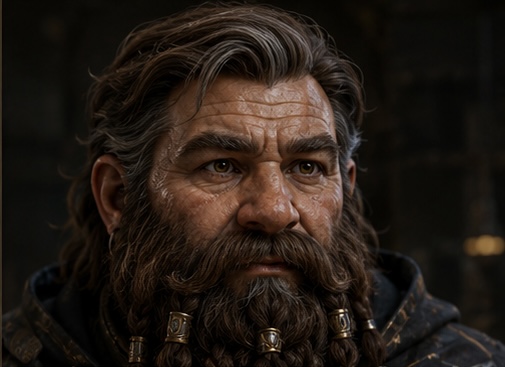
Submitted character story
“People often ask when I first learned to build. They expect me to name a forge, a mentor, or an invention. They are always surprised when I answer: I learned to build when I learned something could be lost.”

Before the planes knew the name Traübon Rängrim, before artificers studied his designs and scholars catalogued his discoveries, he was simply a dwarf beneath the mountain halls of Khaz Barum.

Born into the Rängrim family, a lineage of engineers and craftsmen, Traübon was raised among those who understood that the world was held together by things most people never noticed. His father taught him the value of function: a mechanism was only as good as the purpose it served. His mother taught him preservation: every creation carried the story of the hands that shaped it.

To the young Traübon, the world was full of unfinished conversations.

A broken machine was not useless.

It was a question waiting for an answer.

Where others saw flaws, he saw possibilities. Where others accepted tradition, he asked why it had to remain unchanged. His first inventions were not weapons or wonders, but simple solutions to ordinary problems—a child’s clever mechanisms born from curiosity rather than ambition.

That curiosity would define him.

It would also challenge him.

Khaz Barum valued mastery. It valued patience, discipline, and generations of proven craft. Traübon respected those traditions deeply, but he believed respect did not mean refusing to improve. To him, the greatest dishonor to a craft was allowing it to stop growing.

Under the guidance of masters who shaped his philosophy, he learned that invention required more than imagination. It required restraint. Knowledge without discipline created chaos. Tradition without curiosity created stagnation.

From the engineer came precision.

From the archivist came preservation.

From the artisan came purpose.

Together, they created Traübon Rängrim.

⸻

When the War of the Shattered Crown erupted, Traübon did not march to battle as a soldier.

He went as a craftsman.

The war itself was born from misunderstanding—miscommunication, fear, and assumptions that grew until entire nations found themselves fighting battles they no longer remembered how to end.

Traübon witnessed firsthand the consequences of things being misunderstood.

A weapon was misunderstood, and it became a tool of destruction.

A people were misunderstood, and they became enemies.

A truth was misunderstood, and it became forgotten.

Those lessons never left him.

During the Siege of Drögen Field, Traübon served along the forge lines, repairing weapons, armor, and siege equipment for soldiers who had little left to give. When the forge was ordered to withdraw, he refused to accept that the problem was impossible.

The forge was failing because the process was inefficient.

The solution was not more suffering.

The solution was better design.

Through ingenuity, determination, and the cooperation of those around him, the forge continued. The defenders held. The city survived.

It was there that Traübon met Aurelia Veylan.

A human battlefield engineer and craftsman in her own right, Aurelia was not impressed by legends. She cared about results. She understood Traübon’s brilliance, but she also understood his flaws. Where he saw systems, she saw people. Where he chased perfection, she reminded him that purpose mattered more than appearance.

Together, they became something greater than either alone.

Their greatest creation began not as a weapon, but as an answer to a simple problem.

Aurelia carried too much.

So Traübon built something to help her.

The first design was recorded in his notes as:

Rängrim Forge Hammer Prototype I.

A marvel of mechanical engineering, rune work, and craftsmanship, it combined the power of a traditional forge hammer with precision impossible through ordinary means.

Traübon saw a machine.

Aurelia saw something else.

She called it:

Old Reliable.

He protested the name.

She ignored him.

Because to Aurelia, the greatest compliment a tool could receive was not that it was impressive.

It was that it could be trusted.

⸻

The years that followed were the quietest and most important of Traübon’s life.

Together, they built a home.

Not a monument.

Not a fortress.

A workshop.

They repaired tools, taught apprentices, helped their community, and created things that made ordinary lives better. The greatest artificer the planes would ever know spent his happiest years not creating legendary artifacts, but making sure doors opened, machines worked, and people had what they needed.

Then time did what no weapon, monster, or enemy ever could.

It separated them.

Aurelia lived a full life.

She did not fall in battle.

She was not taken by tragedy.

She simply grew old.

And Traübon, who had spent his entire existence solving impossible problems, faced the one problem no invention could overcome.

He could repair machines.

He could rebuild cities.

He could create wonders.

But he could not repair time.

⸻

After Aurelia’s passing, the dwarf who had once built with joy became consumed by questions.

He searched ancient texts.

He studied forgotten sciences.

He chased lost knowledge across continents and worlds.

Not because he wanted power.

Because he feared that knowledge itself could die.

Eventually, his pursuit brought him beyond his own plane of existence.

He crossed worlds, studied civilizations, and learned from masters who had long since been forgotten by history. Along the way, he encountered an ancient vessel containing a power unlike anything he had known.

A genie.

Where others saw a source of power, Traübon saw a being with its own history.

He did not demand service.

He offered understanding.

Their pact was not one of domination.

It was collaboration.

The genie lent him fire.

Traübon gave the genie purpose.

⸻

Across the planes, the legend grew.

The hammer Aurelia once carried evolved through centuries of refinement, becoming an artifact recognized throughout the worlds.

Scholars and artisans eventually gave it a name worthy of its craftsmanship:

Brokkr’s Anvil.

But Traübon himself rarely uses that name.

To him, it remains something simpler.

Something older.

Something personal.

Old Reliable.

⸻

Today, Traübon Rängrim stands among the greatest artisans in existence.

A planar traveler.

A scholar.

An artificer of impossible creations.

A master of machines, runes, and forgotten knowledge.

Yet those who truly understand him know the truth.

The Prime Artisan is not remembered because he built the impossible.

He is remembered because he believed everything had value.

Every broken mechanism had a lesson.

Every forgotten artifact had a story.

Every lost piece of knowledge deserved another chance.

And every creation, no matter how small, was proof that someone cared enough to make it.

The planes know Traübon Rängrim, the Prime Artisan.

But those fortunate enough to stand beside him know something far more important:

Before he was a legend…

Before he was a craftsman…

Before he was the keeper of impossible things…

He was simply Bon.