Portrait libraryTobin
Dragonborn / Bard
Submitted character story
There are many great bards in the Sword Coast. There is Volo, whose ability to turn a moderately interesting event into a three-volume epic is rivaled only by his ability to survive things that should have killed him. There are the traveling minstrels of Waterdeep, the moonlit singers of Silverymoon, and the dwarven folk bands of the North, whose drinking songs are less songs and more like organized shouting.

And then there was Tobin the Bold. Tobin was, by his own estimation, one of the greatest bards Baldur’s Gate had ever produced. According to everyone else, he was a bard who happened to be very loud.

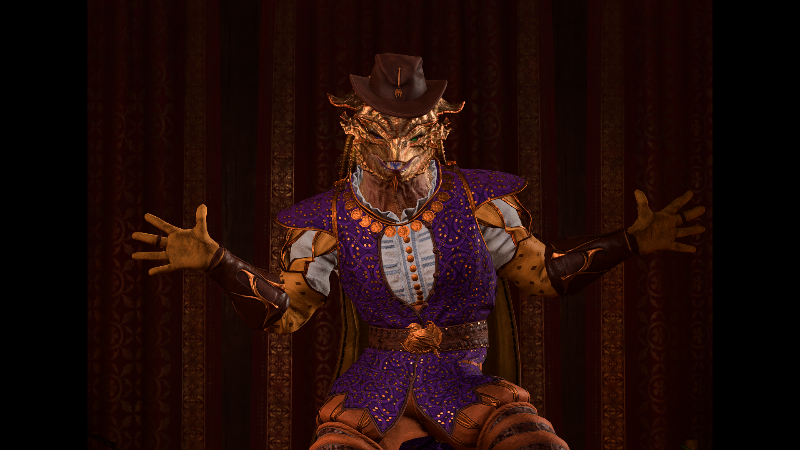
Tobin was a gold Dragonborn of impressive stature, with scales the color of freshly minted coins and a voice that could shake dust from the rafters. He dressed himself in the most elaborate finery he could afford, wore a battered leather hat that he insisted made him look “roguish,” and carried a beautifully crafted lute that he treated with such affection and tenderness that it would make his partners jealous. The lute was named Gertrude—don’t ask him why.

His career began humbly. Very humbly. Painfully humbly. Tobin had started out singing in taverns and restaurants, where he would stand upon a table, clear his throat, and announce:

“Good people! Prepare yourselves for a performance unlike anything you have ever heard!”

The patrons would clap politely. Then Tobin would begin. His first songs were love ballads.

Unfortunately, Tobin’s understanding of romance came primarily from overhearing other people talk about it.

His opening song, Your Eyes Are Like the Moon, compared a lady’s eyes to “two enormous celestial eggs.”

His second song, I Would Cross Ten Thousand Miles for You, was technically about a woman named Maribel, but Tobin would forget her name halfway through and begin referring to her as “Margaret” or “Meredith.”

His third song, There Once Was a Woman from Avernus, was a lurid little ditty unfit for the more romantic venues, but was wildly popular at The Blushing Mermaid.

These performances tended to end with him being thrown bodily from the establishment after visiting the bar and serenading the patrons with Dragonborn throat-singing.

Tobin attributed this reaction to—“the public’s lack of appreciation for an ancient and deeply respected art form.”

And so, after several establishments permanently banning him and one tavern placing a bounty on his vocal cords, he decided that perhaps the problem was his singing. Tobin abandoned the love ballads. Instead, he picked up Gertrude from a traveling merchant, learned the lute properly, and everything changed. Tobin discovered that he had a gift… again.

He could play. He could sing. He could tell stories. And, most importantly, he could make the owner forget that he was standing on their furniture. Soon, word spread across the Sword Coast. Tobin the Bold had arrived. He performed in Baldur’s Gate, Waterdeep, Neverwinter, and dozens of villages whose names he consistently pronounced incorrectly.

His performances became legendary. People would gather by the hundreds whenever they heard he was coming. Women swooned. Men cheered. Children begged their parents to let them stay up late. Bartenders quietly hid their most expensive liquor.

Tobin embraced his newfound fame with remarkable humility, as in an extreme lack of. As his ego grew, his wardrobe became increasingly elaborate: purple velvet, gold embroidery, leather boots, a ridiculous hat, a necklace of coins, a belt buckle shaped like a dragon breathing fire, and a cape.

Tobin loved the cape.

The cape had absolutely no practical purpose, but Tobin insisted that it was essential to his stage presence.

“Without the cape,” he explained, “I am merely a musician.” He dramatically swept it behind himself. “With the cape, I am a legend.”

Unfortunately, this newfound fame eventually went to Tobin’s head—to nobody’s surprise. It began with an ancient scepter. Having been invited by a Baldurian nobleman to play at his private party, Tobin had “found” the staff in a locked case in the back room of the collector’s estate after sampling the large collection of fine wines.

The nobleman had warned him, “Do not touch that.”

Tobin touched it.

The nobleman shouted, “I SAID DON’T TOUCH THAT!”

Tobin raised it above his head.

“Behold! A baton worthy of the king of the bards!”

The scepter began glowing.

Everyone stared.

Tobin stared.

The collector stared.

A nearby dog began barking.

The butler sneezed.

Tobin slowly lowered the scepter.

“…That seems important.”

It was.

“You fool! That scepter is cursed!” the noble hissed.

“How do you know?” Tobin snapped, staring blearily in his general direction.

The man pointed to a sign beneath the scepter’s display case, where in large, blocky letters were the words: CURSED! DO NOT TOUCH. The irate noble then started into a long-winded explanation of the history of the wand and the nature of its curse.

Tobin was too drunk to remember.

The collector went on to express his immense dissatisfaction with the behavior of the bard.

Tobin puked on his shoes.

The noble felt the bitter-smelling sick filling his boots, slowly soaking through his stockings, and was further dissatisfied.

This was only the beginning.

What followed was a seven-day bender of epic proportions, brought on by a duergar liquor made from the fermented mushrooms of the Underdark. The week went by in a prismatic blur full of dancing pink hollyphants, with only a few moments sticking in his mind.

Running down an empty street, a pack of rabid fans snapping at his heels.

Riding a runaway hay cart down a hillside while singing The Ballad of the Man Who Definitely Had Permission to Borrow This Carriage.

Slow dancing with a rented three-legged pony in a moonlit cistern.

A conversation with a platypus who made the statement, “Stick with me, kid, I’ll sell you a million records.”—Tobin wasn’t sure he could trust this platypus, and he didn’t know what it meant by “records,” but it sounded like a good deal.

A memory involving a halfling. A naked halfling. He couldn’t remember why the halfling was naked. Or why Tobin was carrying him. Or why they were both riding a three-legged pony. Tobin later claimed that the halfling was “an important diplomatic representative.” The halfling said that he had never met Tobin before that evening. He didn’t explain why he was naked.

By the end of the seventh day, Tobin had woken up on a strange roof in an unfamiliar town. The ancient scepter lay next to him, stuck inside a roast chicken. A note was pinned to his chest. It read: STOP ASKING THE GUARDS WHERE THE PONY WENT.

Tobin stared at the note. Then he looked at the roast chicken. Then at the scepter.

“Well,” he said. “That explains nothing.”

He had no memory of climbing onto the roof. He had no idea whose roof it was. He was surrounded by approximately thirty-seven people. Some were cheering. Some were shouting. Three were guards. One was a priest. Two were members of a local theater troupe. His mother was there. The naked halfling was there. The three-legged pony was also there. It all made sense; clearly, he was here for a return performance.

Tobin raised his arms.

“Friends!”

The crowd cheered.

“Citizens!”

More cheering.

“People I have never met!”

Tobin pointed dramatically toward the horizon.

“Tonight, we make history!”

The priest was crying.

One of the guards yelled, “Gods help us.”

Tobin raised Gertrude.

“I shall perform my greatest song!”

The crowd erupted.

He began playing.

Nobody recognized the song.

Tobin didn’t recognize the song.

Gertrude probably didn’t recognize the song.

But somehow, it worked. The melody was beautiful. The rhythm was infectious, as if Milil himself was guiding his fingers as they danced across the lute strings.

People began dancing in the streets. Even the guards stopped trying to arrest him. His fans were in the street, pointing up at him. He could hear them practically screaming his name: “TOBIN! TOBIN! TOBIN!”

For one glorious moment, Tobin was exactly what he had always believed himself to be. A legend. A hero. A bard whose music could bring people together. The ancient scepter, unnoticed by anyone, began to glow.

The crowd began to disperse, running in every direction. Tobin turned and looked up. A giant gray nose was hanging in an orange-colored sky, its nose hair undulating in the wind. He stood and watched as the long purple strands stretched down to the city below. One mucus-covered hair was reaching for him, a vision. Tobin stood there, perfectly still, waiting to be anointed by the gods as the greatest bard of all time.

Then—Black.

The first thing Tobin noticed was the headache. It was not an ordinary headache. This was a headache with ambition. A headache that had studied military tactics. A headache that had declared war on his skull and intended to win. Tobin groaned. His mouth tasted like old leather and oysters. He tried to move. Something squelched beneath him. He opened one eye. Then the other. Above him was a ceiling unlike any ceiling he had ever seen. Dark. Organic. Wet. Pulsing. Tobin stared at it.

“…That’s new.”

He slowly sat up. His clothes were filthy and ragged. His cape was gone. His boots were mismatched. His head was bare. Gertrude was nowhere to be found. Tobin patted his pockets. Nothing. He checked his belt. Nothing. He looked around. He was lying inside some sort of strange chamber aboard a massive, unfamiliar ship. Fires were everywhere. The smell of burning flesh filled his nostrils. There were fleshy walls. Strange machinery. Pulsing veins.

Tobin slowly climbed to his feet. His head throbbed. His stomach churned. He had absolutely no idea where he was, how he got there, what happened to the naked halfling, what happened to the three-legged pony, and, most importantly, he had absolutely no idea where Gertrude was.

Tobin placed a hand against his aching forehead. He had no weapons. No lute. No money. No idea where he was.

But he was Tobin the Bold.

And Tobin the Bold had faced angry tavern owners, drunken dwarves, hostile guards, musical goblins, rabid fans, and at least one extremely judgmental goat.

He could handle anything.

Probably.

Tobin stepped toward the doorway. He had no idea that he was aboard a Mind Flayer Nautiloid. He had no idea that strange things were crawling through its corridors. He had no idea that a parasite had been placed inside his skull. He had no idea that the Sword Coast was about to become considerably more complicated.

He had no idea that he would soon be traveling with a group of people that seemed to have crossed every god, demon, and undead sociopath in the realms.
He only knew three things. His head hurt. His lute was missing. And he was fairly certain he had forgotten to return the pony.