Portrait libraryThalén
Halfling / Wizard
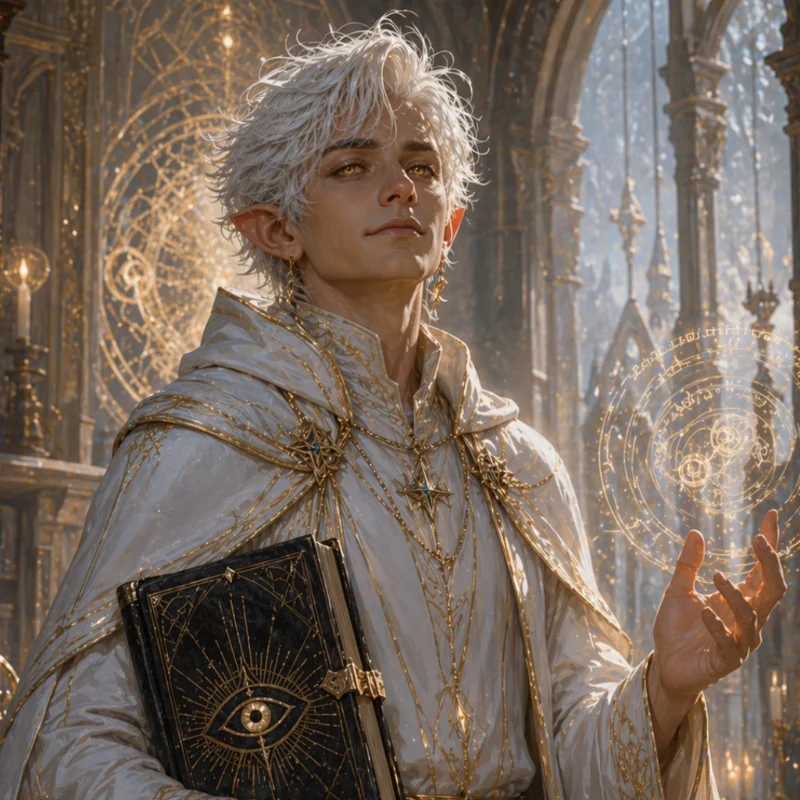
Submitted character story
On the routes of the Western Heartlands, between Scornubel and Berdusk, there was an old road that no one considered important and yet everyone used. Caravans passed along it as if crossing something long forgotten by time. Merchants traded beneath the dust of the path. Travelers pressed forward, eager to reach anywhere that wasn’t there. It was an ordinary road—the kind of place where nothing should begin. And yet, it was exactly there that everything began.

On an unremarkable morning, a halfling baby was found by the roadside. There was no broken wagon nearby. No blood or any sign of attack or recent abandonment. Just a child.

Wrapped in a simple cloth, too dry for that road, as if it had been placed with care—or forgotten with intention. There were no names, symbols, or any hint of origin.

The travelers who found him didn’t know what to do. But halflings are good at simple decisions when the world becomes too complicated. So they took the child.

A few days from there, in the gentle hills near Berdusk, there was a small halfling community called Brightburrow (Colina Brilhante). It was a place built on continuity, not haste. Homes carved into green slopes like comfortable burrows. Gardens that always seemed to be in bloom. Nights filled with soft music, stories lovingly repeated, and laughter without reason.

There, the unfamiliar was not rejected. It was softened until it felt familiar. And there, they gave the baby a name: Thalén.

Thalén grew as those who don’t draw attention often do: surrounded by care, but not by answers. He wasn’t a difficult child, just… displaced.

While the other halflings lived within the rhythm of the village, Thalén always felt half a step outside it. He observed too much, spoke too little, and sometimes answered questions before they were spoken aloud.

At first, they said it was imagination. Then they said it was intuition. Later, no one knew what to say anymore.

Because there was something stranger than his answers. Thalén heard thoughts—not as a clear voice, but as pressure in the mind, fragments of intent, echoes of something not yet spoken. He caught what people wanted to say—what they truly meant. And there was no control over it. No filter.

Brightburrow became too loud, too invasive. So he made the only move that felt right: he withdrew.

It was in that isolation that he began to draw.

At first, simple sketches: shapes, trees, paths. Then the lines began to take forms that didn’t obey the page. A drawing would start in one corner and end in another, as if interrupted by something unseen. Elements repeated at impossible angles. Figures appeared layered, as though multiple versions of the same moment were competing for space.

No one understood it. Not even him.

Until an incident happened in the village.

A caravan wagon from Scornubel arrived in Brightburrow at dusk. It was routine: trade, stories, and news from the outside world. But that night, Thalén drew without realizing what he was doing.

The drawing was distorted, with multiple overlapping images, incomprehensible lines to any other eye. But to Thalén, it was clear. The wheel breaking before the impact. Fire appearing where no flame should be. And a strange figure, repeated in multiple positions, as if it existed outside the scene’s time.

He showed the drawing to no one. But the next day, the wagon did break—exactly as it had on the page.

The coincidence might have been forgotten, if not for the rest.

The figure in the drawing—the only thing that made no sense—was seen at the site of the accident.

In distress, he shared this with his adoptive parents, who in turn brought the matter to the village chief. And that was enough to change how Brightburrow began to look at Thalén. A silence that settles when something ceases to be understood.

Years later, a traveler arrived in Brightburrow.

His name was Ithram Valoss, a scholar of Candlekeep. But before that, he had been many things—among them, an old acquaintance of the village chief.

The meeting took place in the communal house, where halflings received visitors, exchanged stories, and handled matters that didn’t fit into the rhythm of daily work.

Thalén was there. Not by the village’s choice, nor by exclusion. He simply… was always nearby when they spoke about him, as if something within him drew him toward his own mysteries.

That day, he remained silent in the corner of the room.

The chief of Brightburrow welcomed Ithram with a cautious smile—the kind belonging to old friendships that survived time, but not distance.

“You took longer than I expected, Ithram,” he said. “Did Candlekeep hold you tighter than the world outside?”

Ithram smiled faintly.
“Candlekeep never holds anyone. It only shows how the rest of the world is too small for certain questions.”

A brief laugh rippled through the room. Familiarity softened the air.

Until the chief’s tone shifted.

“Since you’re here…” he said, glancing toward where Thalén stood, “I’d like your opinion. You always had a better eye for patterns than I did.”

Ithram followed the glance—and saw Thalén.

“His drawings,” the chief continued, more serious now. “He can’t explain what he does. But… sometimes, things happen afterward. Small things. Sometimes too large to be coincidence.”

The silence that followed was not uncomfortable. It was attentive.

Ithram asked to see the drawings. Thalén brought them without enthusiasm.

There was no pride in them. No shame. Only a strange neutrality, as if he had never decided whether it was a gift or a mistake.

Ithram took the pages—and did not speak at once.

He studied them. At length. More than someone merely curious would.

His eyes did not follow images. They followed relationships. Distances. Repetitions. Breaks in continuity.

Then, for the first time, he looked directly at Thalén.

Not as a child. Not as a curiosity. But as someone recognizing a phenomenon that should not exist in a place so small.

“This is not art,” Ithram said at last.

The chief frowned.
“No?”

“No. These are intersections.”

The word lingered in the air.

Thalén said nothing. But he felt its weight, as if he already knew its meaning before hearing it.

“Explain,” the chief said, crossing his arms.

Ithram hesitated for a moment—rare for him. Then he chose his words carefully.

“These drawings don’t show what happened… nor what will happen. They show where different possibilities collide.”

He turned a page.

“It’s as if the world tries multiple versions of itself at the same time—and he… records the points where those versions conflict.”

Silence.

“You’re saying he predicts the future?” the chief asked.

Ithram shook his head.
“No. He sees the moment when the future has not yet decided which version will exist.”

Thalén pressed his fingers against his knee.

He didn’t like the conversation. Not because he didn’t understand—but because he understood too well.

Ithram closed the drawings for a moment and looked back at the boy.

“This is not common, even among those who study omens their entire lives.”

“And what does that mean?” the chief asked.

Ithram took a second longer than necessary to respond.

“It means he isn’t seeing the world as it is.”

He paused briefly.

“He is seeing the world as it could still become.”

The silence that followed was different. Heavier. More real.

And for the first time, Thalén realized the problem wasn’t only what he saw—it was what others were beginning to see in him.

“And is that… dangerous?” the chief asked, more quietly.

Ithram did not answer at once.

“It depends,” he said at last. “On how much he tries to understand—or how much he is forced to understand without guidance.”

“You always answer like that.”

“And you always ask questions that have no simple answers.”

Their old friendship resurfaced for a moment—but didn’t last.

“He is one of ours, Ithram,” the chief said firmly. “If something is wrong with this, we’ll handle it here.”

Ithram nodded.
“And that is exactly why I came back.”

That night, the conversation continued—but not in the common room.

Ithram asked to speak with Thalén alone.

They went to one of the outer tunnels of the hill, where the village’s noise faded enough that even thoughts seemed quieter.

“Have you ever tried to stop what you see?” Ithram asked.

“I don’t know how.”

“But have you wanted to?”

Silence.

“Yes.”

Ithram nodded.
“And that is exactly what concerns me.”

He opened his bag and took out two books. One of them, Thalén recognized. The other was smaller, older, with a dark cover marked by nearly faded lines.

Ithram handed it to him.

“In Candlekeep, knowledge is not only stored. It is contained.”

As soon as Thalén touched the book, he felt something different. It wasn’t active magic. It was expectation.

“This is not a common gift,” Ithram said. “It’s an invitation.”

Thalén looked up.

“Come with me to Candlekeep.”

The offer was direct.

“There, you’ll find records of things no one in Brightburrow should need to understand. And perhaps you’ll find limits to what you do without realizing.”

“And if there are no limits?”

“Then you need to discover them before the world does it for you.”

By the next morning, the decision had already been made.

There was no grand farewell. But something about that goodbye was different.

Before he left, the chief placed a hand on his shoulder.

“Come back knowing more than when you left. But don’t come back too different.”

Thalén did not respond. Because he didn’t know if that would be possible.

During the journey, Ithram spoke little. Until one night, he explained the second book.

“What you carry is not an ordinary book. It is yours.”

“I’ve never written in it.”

“And yet, it has already begun.”

That night, Thalén opened it.

The pages were almost empty. Almost.

Thin lines began to appear—not drawn, simply emerging.

“A grimoire,” Ithram said. “But not like the others.”

He looked at Thalén.

“You won’t fill it with spells. You’ll fill it with intersections.”

The pages shifted slightly.

And among lines that were not yet fully real, something began to take shape.

Not as prediction—but as possibility.

That was how Thalén ceased to be merely the strange boy of Brightburrow—and began to become something even Candlekeep would struggle to classify.

A student. A risk. An observer of realities that had not yet decided to exist.

And when the towers of Candlekeep rose on the horizon, solid against the sky, a single thought formed clearly in Thalén’s mind:

If the world was made of recorded stories…
He was what existed before they were written.

"Thalén left his hometown at seventeen and only returned many years later. He failed to keep the promise he made when he departed, but he became a better person—at least in his own eyes.
Today, Thalén is considered one of the greatest divination apprentices of his generation.
He is currently thirty-three years old."