Portrait libraryOmpar Koesku
Emancipated Stone Golem / Unarmed Brawler
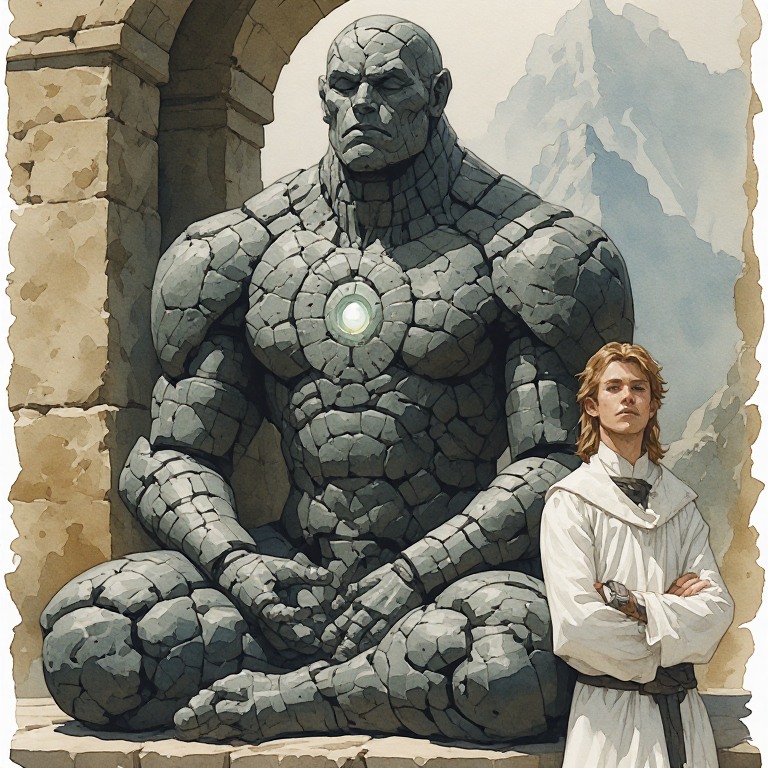
Submitted character story
Carved from the living rock of the mountain, it did not know time, or place, or certainly not *I*. Others were carved, and given life, and moved to service. The carvers, however long they existed, disappeared into silence of an age.
Until the boy.
Aral, a disciple of the Observatory temple, had been captured with all the others, pressed into slave service with his fellow acolytes and priests and unfortunate villagers and travelers in the old mountain mine, Halvrek, by its new, rough proprietors. Aral was slight, and young, and had been taught to look upward, to read the slow wheel of the heavens and find in it the will of distant and patient gods. The mine taught him to look down in a hard school that took more than it gave, but sometimes gave the unexpected.
Aral watched the golems, the many half-built, the several complete and inert, the very few active in service to his masters. A quiet, but good study, he listened, and being a slave, he had nothing to do with what scraps he learned than remember them. He learned the words the bandits said over the stones, when a newly carved gem was brought to a still stone form. He did not know the meaning of the words, but he felt their power. Not divine invocation, but arcane syllables formed by years of study. Aral thought, because he was who he was, that despite being invoked by rote by his masters, the words were, or could be, a kind of prayer.
He was not entirely wrong.
Months into servitude, freedom arrived with violence, the way it often does. Strangers with steel, and spellfire, and..song? Bandits dying or running, slaves scattering, and in the thick of it, a shift of momentum the wrong way. Nearly unstoppable golems following orders, pressing the strangers, bearing down, with injuries mounting and reserves dwindling, the question of survival, much less victory grew ever more uncertain.
Aral answered it.
He’d run, but turned back. He’d watched from hiding, and then he acted. He climbed the dark figure in the third gallery, the largest, most still, completed stone form left in the mine. A pale stone in his fist, one he’d pulled from the rock that very day, he set in the empty socket in the figure’s chest, and he said the words. He should not have been able to. The words weren’t his; the power wasn’t his. But Aral turned the arcane dictate into a prayer, and poured his faith into them, and turned that questing faith from the stars and moons above to the rocks below, with brightness, no, the *mass* of his spirit. behind them. Something in the mountain, or under it, listened.
The socket took light, stone shifting and closing around it to hold it fast. The stone became aware of time, of place, of the desperate need of the delicate energy that had called it. Of decision.
*I*, thought the thing in the third gallery, for the first time, and stepped down off its plinth, and into the fight. And the fight was over.
The boy named it Cairn.
He did it almost carelessly, in the exhausted hours after, because a thing that had saved his life ought to be called something and he knew it had no other. A cairn is a stack of stones a traveler leaves to say the way is here, to mark a grave, a summit, a pathway. It was as good a word as any and better than most, and Cairn wore it for a long time and did not think to want another, because wanting like most things he learned, came slowly, in order, the way one learns to walk.
Much happened in the months and years that followed, and Aral tells it better, especially the parts about people in it. A stone, however tells it as stone does, which is to say by the road.
When the strangers, The Bards of Geon, the world would later call them, went on from the mines to their next troubles. At that time they were newly formed, and tired and in a hurry. They departed with troubling news from the restored Observatory temple, traveling by steed and spell and shadow itself in the swift and dangerous ways such folk use. They told Aral where they were destined - the city of Laisa on the coast, and then across the sea.
Cairn and Aral set out on foot following not their path, but their direction. Aral took the name Koesku - Stone Oath - as his old name no longer held meaning. Aral could no longer feel the call of the sky. It only seemed sensible to move with Cairn over and through the land that they could both feel under them. The pair crossed the better part of a continent that way, and the line they walked was very nearly straight, because Cairn did not see the sense in going around a thing he could go through, and Aral learned to trust the going. Rivers did not stop them. Nor did winter, nor mountains, nor the polite suggestions of men with tolls to collect. They stopped only to help, when helping was asked or plainly needed, and then they went on, and the rolling road, the motion, the not-stopping, became a kind of prayer of its own. Among the oldest of prayers: keep the promise you are already keeping.
Fortune or fate is also a road - one that arrives at the destination when it needs to. The pair arrived at Laisa at no particualr time, and at the hour of greatest need, which the boy would call the grace of his new god and Cairn might have called the nature of a thing that never turns aside. An intrigue, a plot, uncovered by the Bards over many days, was breaking open there with city-wide conflict in the balance; arrows were nocked that were about to fly in an over-crowded, over-tense city square. When a low rumble signaled what seemed to be the arrival of a mountain. Cairn stood in front of, and for the people who could not stand, a second time, and this time Aral, no longer quite a boy, stood beside him, his own powers not quite as new, not quite as untapped. Between the weight of the one and the craft of the other, arrows found stone instead of flesh, and the music of the Bards had time to form and turn the tides of the fight and the hearts of men with surprisingly little blood shed.
Then the Bards took to the sea, and the road, for once, did not follow. Cairn and Aral had no debt, and no duty save that they gave to each other. They had the strange, wide freedom of having nowhere in particular to be.
In that freedom Cairn finished becoming.
Sentience is not a lamp that is simply lit. It a tree that grows from a seed. It is a volcanic shield build from seeping lavas - slow, steady flow instead of explosive eruption. Somewhere in the seasons around Laisa, in the small adventures a young man and a giant found, the harbor work, the long evenings when Aral read aloud from books about the world Beneath and the Hearts of Stone, Cairn listened to the shape of a faith that had a place in it for things like him. The great volcanic shield built into a mountain. Cairn found that he had preferences. That he minded things. That the word I, which the boy's faith had struck like a spark off a flint, had caught and was burning low and steady and would not now go out.
And with that came the knowledge, which he could not un-know, that the light in his chest was still a leash, and that somewhere a word existed that could stop him mid-step, and that he had not chosen the hand that held it. He had only been fortunate in whose hand it was.
Aral learned there was a way to change this. Of course he did; he had become a priest of the god of buried things, and buried things were his particular study. The way was a rite, old and disreputable, that the arcanists called an obscenity and the star-watchers could not have conceived. An unbinding of a given name.
They did it at the bottom of things, on the bare ground of an old quarry away from the city, the way the rite requires; The Weight Beneath cannot hear you when you are standing on someone else's stone. Aral set a second gem, carefully cut, polished to brilliance, in Cairn's open palm, a gem cut from Cairn's own body, from the deep of his shoulder where he would feel the lack of it forever after; and he named aloud the labors the great figure had been made for, the leash it had been given. You were made to carry. You were named to obey.
And Cairn closed his hand and crushed the gem to dust, which no bound thing has ever been able to do, and the two of them together worked the dust into the seat of the light in his chest, filling the facets of that cut stone into smoothness.
Three times Aral, the priest, asked: What is your name?
Twice he said nothing, because the true answer was not yet emerged from the deep.
The third time he gave a name that no one else had ever given him. He said, Ompar. He did not know where it had come from. That is the point of it; that is the whole of the freedom; that it came from no hand, no heart, no *mind* but his own.
The very stone itself acceded. Ompar felt it the way one feels a great door close somewhere far below: the leash was not broken, but turned, made into a thing he had tied himself, an obligation sworn by stone to stone. He was lighter now, and heavier. Freedom weighs more than obedience; the God had told them so, and the God Below does not lie about weight.
When it was done, Ompar turned to Aral and told the the slight man, no longer soyoung, who had climbed a dead thing in the dark and said a prayer he had no right to and been answered, and pointed to himself saying I am. I am Ompar Koesku.
So there are two of that name now, where before there were none. Aral Koesku, who looked up all his childhood and then looked down and found a brother. And Ompar Koesku, who was not even furniture, and then was a tool, and then was Cairn, and is now, at last and by his own word, himself.
Ompar still does not turn aside for much. Some things, weight teaches, are not worth carrying, but one thing always is: the promise you are already keeping. He keeps his. He keeps it freely now, which the God says is the only promise worth the stone it is sworn on.

--
Ompar and Aral were NPC's in a multiyear campaign I ran with a party of four bards - essentially the Beatles Save the World. But Aral, and especially Ompar grew into something I wanted to keep.