Portrait libraryHekate Longmorn (Lothdot)
Human / Sorcerer
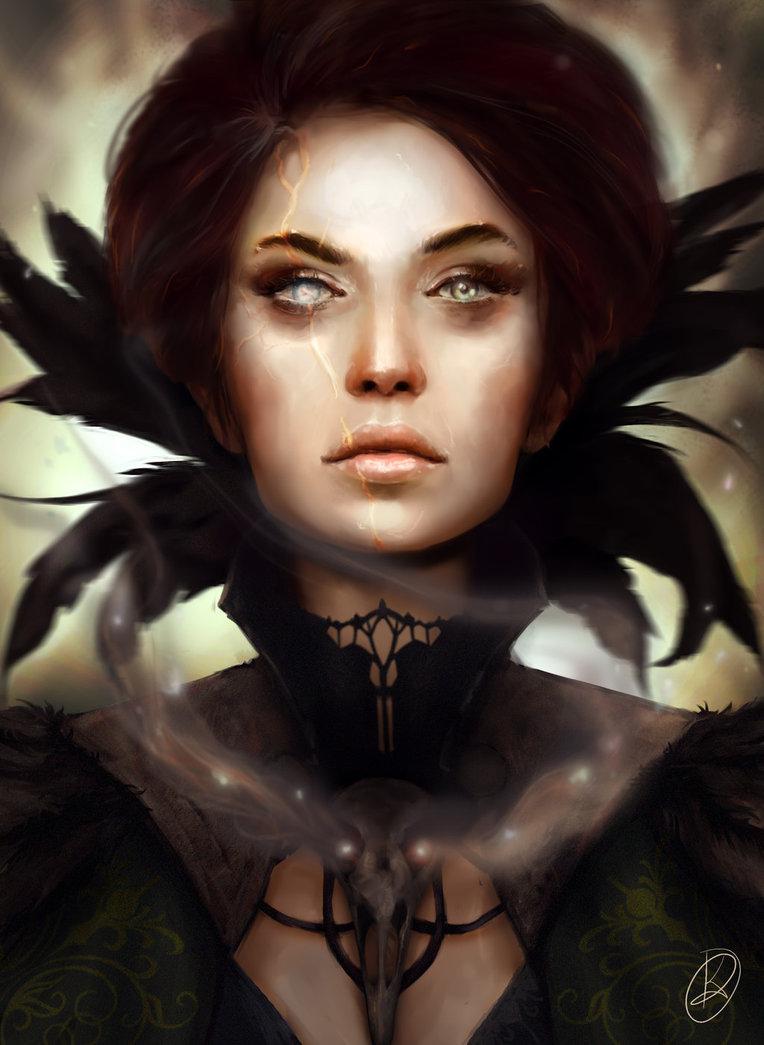
Submitted character story
Hekate Danae Longmorn (née Lothdot) is a complex figure, She is the head of House Longmorn in Derlusk, marked by a tragic past and an exceptional magical nature.
Although raised as a Longmorn noble, Hekate was actually adopted. She was found as a newborn in a basket on a beach and taken in by Nestor and Andromeda Longmorn. Her true family, the Lothdots, were decimated by a metaphysical disease linked to the deity Toldoth. Hekate is the sole survivor thanks to a dark crystal necklace that serves as a protective anchor for her soul.
Hekate possesses a "hypertrophic" soul, characteristic of those who do not study magic academically but manifest it through visceral instinct. She is commonly seen as the last witch of Derlusk. She uses the Shadow weave as her powers come from her connection with Toldoth. Although her magic initially manifested through fire-related effects, her Lothdot origin connects her profoundly to the Shadow, which she has sworn to keep at bay. She is currently busy investigating what her family actually did to keep Toldoth confined and she is trying to restore those rituals. Her goal is to "right the wrongs" committed by her predecessors to ensure a better future for her cousin Nike.

Hekate appears as a resilient and proud woman, bearing the physical and spiritual marks of her own shame and power, determined to redeem her name in a bureaucratic and rigid society like Derlusk's.

In the place where the subterranean river Tyrsdan emptied its dark waters into the ocean, a bustling port city thrived on the nexus of culture, coin, and secrets. It was here, where the waves lapped against stone docks, that Hekate Danae Longmorn grew up.

She lived in a world where time seemed to slip like fine sand through her fingers, moving with a cruel speed born of envy for her fleeting moments of happiness. By fifteen, her beauty was beginning to bloom, a delicate and dangerous thing. Looking back, she realized it was a tapestry of catastrophe she had been weaving around herself all along. And perhaps, if her family had chosen anyone other than Zephyrus to guide her, the threads would never have knotted so tightly.

Hekate’s lineage was noble, but her household was forged in blood and silence. Her father, Nestor, was a hardened man who had watched his entire family die of a mysterious wasting sickness when he was just seventeen, leaving him with only his infant brother, Zephyrus. Her mother, Andromeda, was no softer, having miscarried every child she ever carried until Hekate. Though they loved their only daughter deeply, they were casualties of their own grief, entirely incapable of showing affection.

Driven by the fierce competitive spirit of the city, they pushed Hekate to the brink of physical exhaustion on the training grounds. Yet, she was an inherent disappointment in the art of war; she simply could not wield a sword. As a gaunt, frail girl, she would stare at her mother’s broad shoulders, shoulders that looked capable of bearing the weight of a suit of armor, a noble house, and the entire world, and feel utterly inadequate. While Andromeda’s muscles moved with tireless, lethal grace, Hekate was always the breathless child, bruised and caked in the dirt of the courtyard. From the shadows, Nestor would watch them, his brow permanently furrowed with a grim worry for the future of his legacy, looking down at his daughter as if she were nothing but a fragile bundle of twigs and bruises.

Where her body failed her, however, her mind excelled. When she was ten, her uncle Zephyrus, then a young man of twenty-five, recognized her voracious appetite for reading and started placing more and more books into her hands. Under his tutelage, Hekate tasted validation for the first time. He made her feel capable, worthy, and possessed of a value she could finally present to her stern father.

But the fragile peace of her youth shattered when Zephyrus married Thalia, a breathtaking woman of immaculate breeding. Thalia was an angel incarnate, with cascading golden hair and a face so gentle it could move a heart to tears. Hekate, who had never felt envy on the training grounds, found herself consumed by it. Thalia had everything Hekate desired: an athletic yet elegant frame, an ethereal beauty, and a brilliant mind.

Worse still, Thalia was a mage. Hekate vividly recalled the day she asked her new aunt to demonstrate her gifts; six tiny, stylized lights danced in a perfect circle around Thalia, casting a radiant halo upon her golden hair as if celebrating her perfection. But the truest, most agonizing burn was the way Zephyrus looked at his new wife. Hekate watched them laugh, watched him lean down to press a tender kiss to Thalia’s head, and felt a quiet fire ignite in her chest.

It took three more years, and the birth of their first daughter, Nike, for Hekate to truly understand the poison in her heart. She did not envy the golden-haired, blue-eyed infant, though the child stole Zephyrus's attention. No, Hekate realized she wanted to be in Thalia’s place. She wanted her uncle to love her with that same consuming devotion. She wanted his kisses for herself. She knew it was wrong, a transgression against nature and family, but the longing refused to die.

By the time Hekate turned fourteen, the laws of nature played a trick on her. The gaunt, awkward girl vanished, replaced by a woman of striking beauty, with long, undulating brown hair and emerald eyes that commanded the attention of strangers in the street. Her parents, seeing her martial failures, immediately began plotting to leverage her looks into a politically advantageous marriage. But Hekate’s mind remained fixed entirely on Zephyrus.

She noticed that the initial domestic bliss between her uncle and his wife had cooled under the exhausting demands of parenthood. Thalia, battered by childbirth, was no longer the vibrant creature she once was. Hekate, by contrast, was a breath of unbroken spring.

The turning point arrived in the quiet sanctuary of the family study. The room was thick with the scent of lush, year-round flowers that Thalia kept alive through subtle magic. Zephyrus sat reading, framed by the elegant furniture and familiar leather-bound histories. To Hekate, he had never looked more beautiful.

She stepped inside, locking the door behind her. Testing the waters, she engaged him in a conversation about a fictitious older boy she claimed to fancy, asking him what love felt like before she was bartered away into marriage. Zephyrus, operating under the guise of a protective uncle, warned her that men would take advantage of her, reminding her that Nestor would kill them both if he discovered she had compromised her virtue. When he softly asked who the lucky man was, Hekate replied that it was someone older, someone she had known her entire life. Zephyrus merely handed her a book of romances, telling her to distract herself.

The match was struck during the winter of her fifteenth year. It was her birthday, a day her parents callously ignored in favor of senate politics and estate management. Sensing her isolation, Zephyrus took her for a walk along the docks. The crisp, salty winter wind whipped around them, and the raucous cries of the gulls sounded almost like mocking laughter. They walked beyond the harbor to a deserted stretch of gray, winter-bitten beach, seating themselves on a bleached log cast up by the tide.

Nervous and plucking at the dry bark, Hekate waited. Zephyrus confessed that her parents had sent him to deliver a truth they were too cowardly to speak themselves. He revealed that Andromeda was barren, having lost all her biological children. Hekate was not their blood; she had been found abandoned in a wicker basket on this very shore, adopted out of a sense of divine destiny.

The revelation hit Hekate in waves: first a profound shock, then a sudden clarity as to why she always felt like an alien ghost in her own home, and finally, a dark, exhilarating realization. If Nestor and Andromeda were not her parents, then Zephyrus was not her uncle.

Zephyrus reached into his coat and produced a token left in her cradle: a stark, black crystal necklace that seemed to swallow the gray winter light. Hekate turned her back to him, lifting her long hair so he could fasten it around her neck. The moment the clasp clicked, she spun around and kissed him.

It was not the kiss of a niece, but of a woman claiming what she desired. For Hekate, a lifetime condensed into that singular, breathless second. When she finally pulled away, staring into his panicked, searching gray eyes, she was a completely different person. The silence between them was deafening. Though he tried to dismiss it as the erratic behavior of a traumatised girl, Hekate begged him not to abandon her, terrified of being utterly alone in a house of strangers. Zephyrus looked at her then—really looked at her—and kissed her back with passion.

A period of secret, stolen happiness followed. Zephyrus swore he loved her, and Hekate allowed herself to believe that when the time came for her arranged marriage, he would find a way to save her. But tragedy struck the household first. A sudden, unknown wasting sickness fell upon Nestor and Andromeda, mirroring the plague that had claimed Nestor's family decades prior. Within a month, both of her adoptive parents were dead, leaving Hekate as the sole heir to the estate, with Zephyrus stepping in as her legal guardian and regent in the senate. Hekate mourned them deeply, realizing too late that they were all cut from the same emotionally stunted cloth: bound by love, but entirely incapable of expressing it.

The clandestine affair continued in the shadows of their grief until, three years after it began, Hekate discovered she was pregnant. She gave Zephyrus an ultimatum: she would not keep the child unless he left Thalia. He refused, trapped by his own cowardice.

In the dead of night, Zephyrus woke her, wrapping her in a heavy cloak and leading her through the dark streets to a squalid shack in the city's outermost slum. A crone stood waiting, ready to rid Hekate of the child. Horrified, Hekate refused to go through with it. A bitter, whispered argument erupted in the alleyways, but Hekate remained unyielding. They returned to the villa in a tense, freezing silence.

Two weeks later, the trap snapped shut. Hekate was alone in the estate with Thalia and the children, studying quietly in her room, when Thalia received a mysterious visitor. Whoever it was delivered the truth. Minutes later, the door to Hekate's study was violently thrown open. The angelic, sweet-faced Thalia was gone, replaced by a creature twisted with pure, unadulterated rage.

Spitting curses, Thalia called her a whore and unleashed a torrent of magic. A searing, agonizing pain tore through Hekate’s right eye as a corrosive spell began to eat away at her flesh. Blinded, weeping, and driven by a lifetime of buried envy and sudden, primal terror, an unknown power surged from deep within Hekate’s soul. She lunged forward to defend herself, but her hands erupted into supernatural, white-hot heat. Ribbons of flame burst from her fingers, catching the hem of Thalia’s dress.

Hekate stumbled backward against the window, tearing down the heavy drapes to frantically wipe the burning, corrosive substance from her face. Across the room, Thalia was screaming, turning into a living torch as the fire consumed her garments. Panic-stricken, Hekate grabbed the discarded drapes and tried to smother the flames, but Thalia, crazed by pain, violently shoved her away. Hekate fled the room, sprinting down the corridor to fetch water pitchers. When she returned, the room was a roaring inferno. She doused Thalia, extinguishing the flames clinging to her body, and beat back the remaining fires with the wet fabric until her strength utterly failed her.

She woke to the cold bite of iron.

Hekate was chained to a cot in a dim cell, her right eye heavily bandaged and completely blind. The guards informed her that she had been unconscious for three days. The magical trauma and the stress of the event had caused her to miscarry her child. Thalia had succumbed to her horrific burns the day prior.

When Hekate desperately asked for Zephyrus, the cold reply shattered whatever was left of her spirit: He refuses to see you.

During the murder trial, Zephyrus sat in the courtroom with a face of absolute stone. To protect his own skin and reputation, he played the part of the grieving, betrayed widower, swearing under oath that he had no knowledge of who had fathered the bastard child in Hekate’s womb. Hekate, bound by a twisted sense of loyalty to her family name and a desire not to completely destroy her own lineage, chose not to expose him. She pleaded self-defense, pointing to her horribly scarred, blinded face, but the court saw only a jealous, calculating girl who had murdered a beloved mother and esteemed mage.

Had she not lost her eye and her baby in the tragedy, the senate likely would have demanded her life. Instead, they handed her a sentence of twenty-five years in the city's deepest dungeons.

A year and a half has passed since the heavy iron doors slammed shut on Hekate Danae Longmorn. The confinement is a slow death, and she would give anything, bargain with anyone, to breathe the salty wind of the harbor once more. The only solace she finds is in the dead of night, when the prison sleeps and the shadows lengthen. In the dark, she whispers words to the air, practicing and molding the volatile magic that awoke within her on that fateful day. Yet, try as she might, she has never been able to recreate the terrifying grandeur of the fire that consumed Thalia. The magic eludes her, leaving her alone in the dark, realizing with a bitter certainty that as terrible as her suffering was on the day she lost everything, the cold, hollow ache of today is infinitely worse.