Portrait libraryDug
Gnome / Illusionist/Fighter
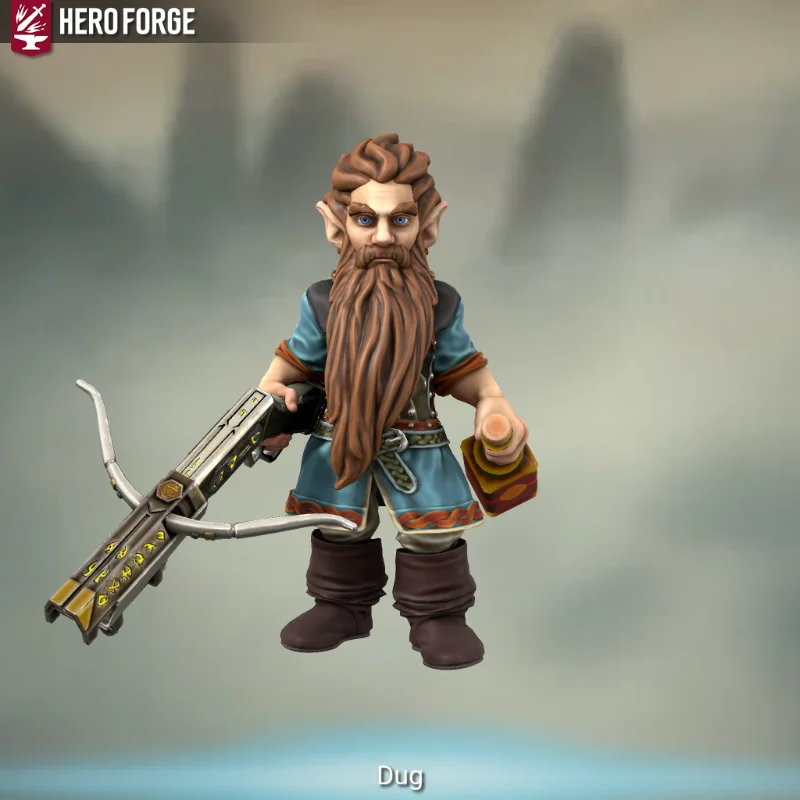
Submitted character story
Dug never meant to become an adventurer.

He was born in a gnomish warren beneath a forgotten hill, the third son of a tinker and a herbalist. He learned to make things vanish—coins, blame, himself—before he learned to read. Illusion came naturally to him. Fighting did not. He was small, even for a gnome, and his first sword practice ended with him dropping the blade on his own foot.

He left home at forty-two, which is young for a gnome, and fell in with a band of human sellswords who needed someone small enough to scout through collapsed tunnels. They called him "the lucky rat." He called them "target practice" after he learned to make six copies of himself dance through a melee while the real Dug picked off stragglers with a borrowed hand crossbow.

The crossbow of speed came later.

He found it in a hoard that wasn't a hoard—a dwarven tomb that had been picked clean centuries ago, except for a false wall he noticed because his dispel magic made the mortar flicker. Behind it: a skeleton wearing a cloak of fading silver thread, one hand still gripping a crossbow that hummed when Dug touched it. He fired a bolt. The bolt crossed the chamber before the sound did. He kept the crossbow.

He kept the drinking habit too.

That same tomb held a cache of aged spirits—dwarven firewine, elven starfall mead, something in a bottle that glowed faintly green. Dug sampled everything. By the time he staggered out of the hills, he had a new favorite hobby and a breath that could knock out a goblin at twenty paces. He learned later, during a campfire accident, that his breath was also flammable. The party's wizard lost his eyebrows. Dug laughed until he cried.

He traveled with many parties over the next thirty years. He saw friends fall to orc axes, to vampire kisses, to traps that should have been obvious. He buried a half-elf ranger who had saved his life twice. He watched a human cleric grow old and die in a safe bed, which somehow hurt more than the violent deaths. He learned not to get too attached. He failed at that lesson every time.

The demon king was his worst failure.

The party had been hired by a warlord of the Ashen Lands—a volcanic chain where the sky rained cinders and the rivers ran with sulfur. A forgotten demon king slumbered beneath a dormant caldera, and the warlord wanted its crown. The pay was enormous. The risk was, Dug later realized, infinite.

They descended through tunnels of obsidian and bone. The demon woke. It was not a king of thrones and courts—it was a king of hunger, a mass of reaching claws and too many mouths, and it had been waiting for fools like them for a thousand years.

The warlord was rent in half. The elf mage's spells fizzled against the thing's hide. The barbarian's axe shattered on the third swing. One by one, the party fell. Dug ran. He is not proud of that. But he is alive, and they are not, and he carries their names on the inside of his left wrist, tattooed in ink made from ash and tears.

He survived because he was small, because he was lucky, and because he made the demon believe—for just three seconds—that a cave-in had already buried him. He cast invisibility on himself and illusion on the rubble, making it look like a fresh fall of stone where he had just been standing. The demon moved on. Dug crawled out three days later, half-mad with thirst, and walked two hundred miles to the nearest town.

He never told the full story to anyone. But sometimes, when the fire burns low, he touches the scar on his left shoulder and whispers a name no one else remembers.

He met Alaertha a decade later.

She was already old. Not ancient, not feeble—but a human woman in her late fifties, her hair streaked with grey, her hands stained with ink from scrolls she had been copying for forty years. She lived in a tower by a quiet lake, and she needed someone to retrieve a grimoire from a haunted library. Dug took the job. The library tried to kill him. He killed it back. He returned with the book, smoke still rising from his crossbow.

Alaertha paid him. Then she asked about his illusions. He showed her. She watched with an intensity that made him uncomfortable and then, somehow, comfortable. She was sharp. Cunning. A little cruel. She asked questions no one else had ever thought to ask—about the edges of illusions, about what happened when two overlapping magics touched, about whether a spell could be stolen mid-casting.

He taught her what he knew. She taught him that an incantatrix could reach into another caster's mind and pluck out a memorized spell like a berry from a bush. He found this terrifying. He also found her terrifying. And then, slowly, he found her wonderful.

They became research partners. Then friends. Then something else.

One night, after too much wine and a successful counterspell duel, she kissed him. Her lips were dry. Her hands were wrinkled. She smelled of old parchment and spell dust and something floral she put in her hair. She was not beautiful by any conventional measure.

He fell in love with her anyway.

The problem came later. Dug did not age. Gnomes live three, four, five centuries if they are careful, and Dug had been very careful. Alaertha was human. By year fifteen of their marriage, she looked seventy. By year twenty, eighty. Her back curved. Her hair thinned. Her eyes remained sharp—she never lost her mind, thank the gods—but she stopped looking in mirrors.

She didn't ask Dug to change anything. She never said a word.

But he saw her crying once. Just once. After a fireplace reflection caught her by surprise. She didn't know he was watching. He stood in the doorway for a long time, holding his flask, not drinking, just… watching.

That night, he cast a permanent illusion on another person for the first time in his life.

Not on her. For her.

He wove a younger face over her features. A straighter spine. A richer color in her hair. He took the woman he had fallen in love with—the woman she had been when they met, the woman she still was inside—and painted her face over the evidence of passing years.

She looked in the mirror the next morning. Paused. Smiled.

She has never asked how. She has never asked why. She just accepts that, somehow, she stopped aging the day she married a gnome.

He will never tell her otherwise.

Now, Dug is retired. Almost. He still takes the occasional fetch quest when Alaertha needs something from a dangerous place—some rare component for her summoning research, some lost grimoire that only a lucky rat can retrieve. But mostly, he stays home.

The tower overlooks a lovely lake. The lake is full of fat, stupid fish. Dug rows out every morning with a pole, a flask, and his crossbow of speed (in case the fish fight back). He catches dinner about half the time. The other half, he catches a buzz and a nap.

Afternoons are for the hot tub—a stone basin he heated with a permanent prestidigitation and a lot of trial and error. He soaks. He drinks. He thinks about old friends. He tries not to think about the demon king.

Evenings, he sits with Alaertha while she reads aloud from her summoning notes. He pretends to listen. She pretends not to notice. Sometimes she reaches over and touches his hand. Her fingers are knotted with age. Her skin is thin and papery.

She is beautiful.

She has always been beautiful.

He just made sure she could see it too.