Portrait libraryAral Koesku
Human / Cleric
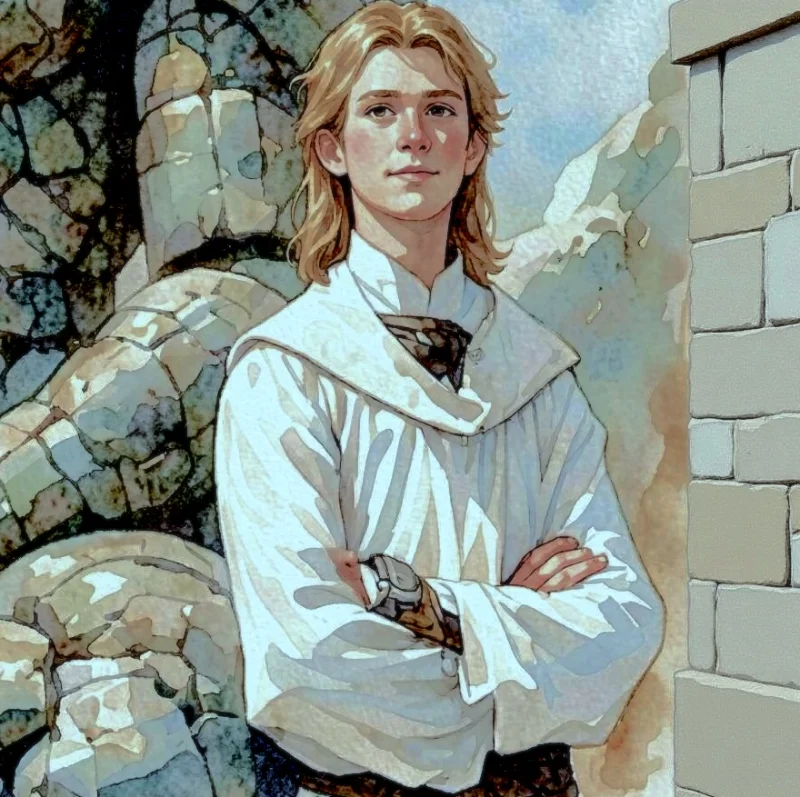
Submitted character story
Aral Koesku is twenty now, or close enough; he stopped noting birthdays somewhere on the road and took to marking distances instead. But he does know it's been two years since the Unbinding ritual that freed his brother Ompar. Two years of walking the land and the bedrock below. Aral has grown into the name he took after leaving the Observatory Temple and its skyward faith. Koesku is 'stone oath' and describes both his brotherhood with Ompar and his allegiance to Durn, god of the earth itself.  The boy who climbed an inert golem in the dark, and spoke a stolen prayer to kindle him, has grown. Now he's priest of Durn, seasoned in his  faith; quiet, unhurried, certain in of the way.

He recounts the beginning sometimes, to those for whom a tale of slavery and freedom may matter, but he rarely thinks about the mine anymore, the Bards who freed him and to whom he later repaid the debt with timely aid. He does think about Cairn before he was Ompar, who grew and changed, and changed him in turn, but he lets Ompar tell that story, because his brother's rumbling voice tells it better.  Aral keeps the part, though, a reminder or a lesson that freeing Ompar wasn't just him liberating a servant. He freed a *place*.

That's something thing about Ompar that Aral learned himself over their miles together, learning from others who saw it first, town by town, and has never really spoken aloud, as it just didn't seem necessary. On the move, Ompar is a sociable giant; a friendly mountain who ducks under lintels he could just as easily remove, who lets children ride the shelf of his forearm, who says slow and careful things that make hard people laugh before they can think to be afraid of him. That is Ompar the person, the brother Aral loves.

But Ompar sits, also. In the evening, or when a hard thing needs thinking all the way through, the great figure lowers himself to bare ground and goes still, and something changes that has nothing to do with Aral's faith, but rather with the ground itself. The mountain settles. The air around him takes on the coolness of a deep cellar, or a laid foundation, of the old, unhurried parts of the earth deciding, for a while, to hold, to simply be. And people come to him, to the place that he becomes. Aral has seen it more times than he can count. In a plague-emptied village a widow sat down against Ompar's side and wept for the better part of an hour, and got up steadier than she had been in months. Once a whole caravan of hard-faced unbelievers, without a word passing among them, laid out their bedrolls in a rough ring around the seated golem the way you bank stones around a fire. A frightened child fell asleep with his back to that stone and woke certain, past all argument, that the world was not going to end after all.

None of them know they are sitting in a temple. Aral does. He is not its priest, Durn keeps no priest set over Ompar. As his own person, like Aral, Ompar answers to Durn directly, the only real difference is the golem was more directly cut from the god's own substance. Aral walks beside the shrine and tends the person who is also, someway, the altar. Each time his brother goes quiet on the bare ground, Aral feels was the new perople they meet also feel, what he never coul quite grasp from his childhood faith in the stars: Here, at least, on this ground, the world will hold.